


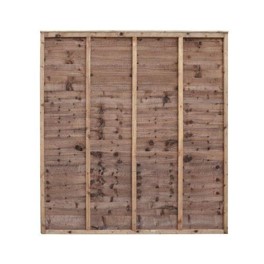
This article looks at the uses you can put waney lap panels too in your garden – and they are on special offer at Suffolk timber specialists Lumberjacks.
It will take between two and three minutes to read.
This month, Lumberjacks is offering 5% off one of the most popular and versatile fencing products you can buy – the waney lap panel. Here we look at some of its main uses – and how to take advantage of this special offer.
What is a Waney Lap Panel?
Also known as overlap or larch lap fence panels, waney lap panel boards are overlapped waney edge boards, positioned horizontally instead of vertically, as with traditional fence panels.
The waney refers to "waney-edge" (or "live-edge") timber, which is a wood plank cut straight from the outer part of a log. Because it comes from the curved, natural edge of the tree, one side is straight and the other is uneven and can even retain some of the original bark.
The lap element refers to the "overlapping" arrangement of the wood. The horizontal waney-edge slats are layered so the bottom edge of one board slightly overlaps the top edge of the one below it.
What Garden Projects are Waney Lap Panels Best Suited to?
Budget-Friendly Boundaries: As one of the most economical fencing options, they are perfect if you have a large perimeter to cover but want to keep your costs down.
Classic Screening: Their layered horizontal slats offer greater privacy, making them ideal for enclosing residential gardens and keeping pets or children safe. And because they are available in multiple heights, you can use them to hide away bins, compost heaps, or recycling boxes.
Quick Installations: They are relatively lightweight, easy to handle, and quick to put up, making them a top choice for straightforward garden projects.
Some Wind Deflection: The nature of the overlapping board construction allows the panels a small amount of flexibility, helping them absorb and deflect mild to moderate winds. However, they may not be strong enough to withstand really high winds, so you may need to choose another type if you live in an exposed area. See our range of closeboard panels if you live in an exposed area and want to have a competitively priced durable panel.
How Can I Order My Waney Lap Panels from Lumberjacks?
At Lumberjacks, we stock sturdy lap panels with a 2½" top and bottom rail on one side to counteract bowing. These panels have five vertical bars each side to enhance their strength. All panels are 1.83m (6ft) wide and come in varying heights listed below.
They are available in 6ft by 6ft, 6ft by 5.6ft, 6ft by 5ft, 6ft by 4ft and 6ft by 3ft. The 5% discount applies to whichever size you order.
To order your waney lap panels from Ipswich-based Lumberjacks, simply click here.
We also stock replacement caps, a decorative finish that sits on top of either your fence or your posts.
Contacting Lumberjacks
As well as waney lap panels, at Lumberjacks we also stock a range of other fencing styles – including decorative, closeboard and various types of trellises. If you aren’t sure which type you need, then read our previous blog post here. You can also call us on 01473 461394, and we will be happy to help.
FAQs
Q: Do Lumberjacks have other products on special offer?
A: Yes – check out our page here. It’s worth checking this regularly as we often add new discounts to various products.
Q: Will Lumberjacks deliver my waney lap panels to me?
A: Yes – we appreciate you may find it difficult to fit them all in your car (however many you need). Delivery charges are calculated via the delivery postcode at checkout. Please enter your postcode when completing your order to get a price. Depending on the size of your order, and where you live, delivery may be free.
For more details, see our deliveries page here.
Q: How long will a waney lap fence last?
A: With proper installation, a pressure-treated waney lap panel can typically last 10-15 years. To maximise their lifespan, ensure they aren't ever sitting directly in standing water or soil, and to periodically apply a wood treatment or preserver.
